When summer temperatures soar past 90 degrees with 80% relative humidity, local homeowners and facility managers know that reliable AC Repair Clearwater FL is absolutely critical to avoid an indoor climate disaster. In Pinellas County, a broken cooling system isn’t just uncomfortable; it represents a major threat to indoor air quality, moisture management, and structural preservation. Many property owners ignore subtle operational shifts until the equipment completely fails, leading to expensive emergency replacements. Fortunately, most air conditioning units give clear warning signs before they experience total mechanical failure. By understanding these red flags, you can intervene early and protect your long-term infrastructure investment.
The Unique Challenges of Florida Climate on HVAC Systems
According to environmental data from the National Oceanic and Atmospheric Administration (NOAA), the Tampa Bay area experiences some of the most sustained cooling degree days (CDDs) in the United States. While an average HVAC system nationwide operates for roughly 1,000 to 1,200 hours annually, a typical system operating on the Florida coast logs anywhere from 2,500 to 3,000 hours per year. This constant thermal loading puts immense structural strain on compressors, capacitors, and fan motors.
Furthermore, the salt-rich marine air blowing off the Gulf of Mexico accelerates galvanic corrosion on outdoor aluminum fins and copper condenser tubes. If these coils are left unmaintained, pitting corrosion creates micro-leaks that bleed refrigerant and crater system efficiency. To combat these harsh local elements, both residential and commercial property owners must partner with a certified HVAC Contractor Clearwater FL who understands coastal environmental physics. This specialized local expertise ensures that routine maintenance protects electrical contactors and electrical windings from premature failure due to salt-air exposure and extreme moisture loads.
Sign 1: Weak Airflow and Hot Spots
A primary mechanical indicator of system degradation is a noticeable drop in airflow or the sudden development of hot spots across your architectural layout. When a system can no longer maintain uniform static pressure throughout the ductwork, certain rooms quickly turn into stagnant saunas while others remain cool. This imbalance often stems from a failing multi-speed blower motor, a frozen evaporator coil, or a breach in the attic ductwork where conditioned air escapes into 130-degree unconditioned spaces.
When airflow is restricted, the compressor must work twice as hard to achieve the temperature setpoint on your thermostat. This prolonged cycle spikes energy consumption and risks liquid refrigerant flooding back into the compressor, which causes fatal mechanical slugging. For property owners noticing these thermal variations, scheduling comprehensive HVAC Services Clearwater FL is the most effective way to analyze duct static pressure and verify system balance. Addressing airflow issues immediately prevents a minor air restriction from cascading into an expensive, system-wide failure.
Sign 2: Strange Noises (Banging, Squealing, or Grinding)
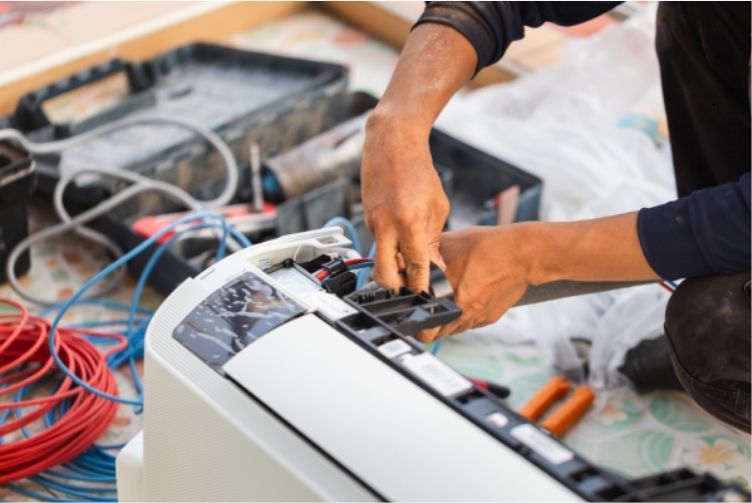
Modern cooling systems run on tight mechanical tolerances designed to operate with minimal noise. Any deviation from the standard hum of a condenser fan or blower indicates internal mechanical distress. For instance, a high-pitched squeaking or screeching sound generally points to a dry blower motor bearing or a slipping serpentine belt in older commercial air handlers.
Worse yet is a loud grinding noise, which signals that the motor bearings have completely lost lubrication and are grinding metal-on-metal. If you hear rhythmic banging, clattering, or metal-on-metal clanking from the outdoor compressor unit, shut the system down immediately at the service disconnect. This symptom points to a loose connecting rod, broken internal spring mounts, or a crankshaft component spinning free inside the hermetically sealed housing. Continuing to run a unit in this condition will cause loose metal to puncture the shell, requiring a complete equipment replacement. Promptly calling for targeted Air Conditioning Service in Clearwater Florida allows a technician to isolate the mechanical failure before it destroys the compressor core.
Sign 3: Unexplained Spikes in Utility Bills
A sudden, unexpected surge in your monthly electric bill is a data-driven indicator of a system operating far outside its optimal performance curve. While seasonal utility increases are expected during peak July and August heatwaves, your consumption should remain relatively proportional to historical year-over-year data. If your kilowatt-hour (kWh) usage jumps by 20% to 35% without an accompanying shift in weather or occupancy patterns, your air conditioner is struggling to keep up.
This drop in seasonal efficiency usually occurs when the system’s subcooling and superheat levels are off due to a slow refrigerant leak, or when the outdoor condenser coils are caked in a thermal barrier of dirt and salt crust. When a system runs longer cycles just to pull down the temperature, it burns excess electricity and degrades component life. Investing in regular Air Conditioning Service in Clearwater Florida ensures that your system’s Seasonal Energy Efficiency Ratio (SEER) rating remains optimized. For neighbors just a few miles north, securing timely AC Repair Palm Harbor FL can similarly catch these efficiency drains before they result in thousands of dollars in wasted power bills.
Sign 4: Frequent Cycling or Short-Cycling
Short-cycling is one of the most destructive operational anomalies an HVAC system can experience. This occurs when the air conditioner boots up, runs for a brief period of three to five minutes, and then abruptly shuts down before completing a full sensible and latent cooling cycle, only to turn back on moments later. The start-up inrush current (measured in locked rotor amps) draws the highest electrical load, creating intense thermal stress on the start capacitors, run capacitors, and compressor windings.
Short-cycling is frequently caused by a malfunctioning low-pressure switch, an overheating internal limit, or an oversized unit that rapidly cools the room air without removing the latent heat (moisture). In Florida, this is a disaster because an air conditioner must run long enough for the evaporator coil to squeeze moisture out of the air. Short-cycling leaves indoor spaces feeling humid and clammy, creating a prime environment for indoor mold colonies. Resolving these electrical and pressure imbalances requires advanced diagnostic tools provided through dedicated HVAC Services Clearwater FL to protect the integrity of your system’s electrical controls.
Sign 5: Foul Odors and Excess Moisture/Leaks
Indoor environmental comfort relies heavily on source control and moisture management. If the air stream exiting your supply registers carries a distinctly musty or earthy odor—often referred to in the industry as “Dirty Sock Syndrome”—it means microbial volatile organic compounds (mVOCs) are growing directly on your damp evaporator coil or within the dark turns of your ductwork. Conversely, a sharp, metallic burning smell indicates that wire insulation is melting or a blower motor is drawing excessive amperage and shorting out.
Liquid water accumulation around the indoor air handler pan is another critical warning flag. In our humid climate, a cooling system can pull multiple gallons of water out of the air daily. This condensate drains away via a PVC line, but algae and bacterial slime can easily choke the pipe, causing water to back up and overflow. This can ruin drywall, rot subfloors, and destroy ceilings. When moisture builds up or odors appear, getting professional Air Conditioning Service in Clearwater Florida to clear lines with high-pressure nitrogen and sanitize the coils is paramount. Proactive homeowners know that ignoring these signs means they will eventually face a total system shutdown, making urgent AC Repair Clearwater FL unavoidable.
DIY Troubleshooting vs. When to Call a Pro
There are several baseline preservation steps a property owner can manage independently to maintain efficiency. Homeowners should inspect and swap out standard pleated or fiberglass air filters every 30 to 45 days to keep static pressure low. Additionally, keeping the outdoor condenser pad free from overgrown landscaping, mulch, and lawn clippings allows for uninhibited heat rejection.
However, complex mechanical and electrical diagnostics require specialized technical training. Under federal EPA Section 608 regulations, handling, recovering, and charging refrigerants like R-410A or R-32 is strictly restricted to licensed professionals. Attempting to test a high-voltage dual-run capacitor or diagnosing a faulty compressor relay without proper safety gear poses a severe arc flash and electrocution hazard. When a system issue goes deeper than a dirty filter, hiring a licensed HVAC Contractor Clearwater FL is necessary to preserve your manufacturer warranty and keep your building safe. For commercial managers and homeowners across the county line, working with an authorized HVAC Contractor in Palm Harbor FL ensures the same high level of regulatory compliance and mechanical accuracy.
Advanced Diagnostics & Data-Driven Maintenance
To keep commercial facilities and residential homes operating at maximum efficiency, modern technicians rely on electronic manifolds, digital hygrometers, and thermal imaging cameras. Evaluating the exact temperature split across the evaporator coil—ideally between a 16-to-20-degree Fahrenheit delta—gives definitive data on whether the system is removing heat effectively. When these metrics drift, it indicates hidden mechanical resistance that will eventually stop the system completely.
For properties experiencing erratic performance, investing in professional HVAC Services Clearwater FL provides the deep data analysis needed to identify weak components before they leave you stranded in a heatwave. Regular diagnostic checks track electrical amp draws against the manufacturer’s data plate, ensuring motors aren’t running hot or drawing excess power. Catching these discrepancies early through targeted AC Repair Clearwater FL saves property owners thousands of dollars in premature compressor replacements and minimizes operational downtime.
Final Thoughts On You Need An AC Repair Clearwater FL
In an unforgiving climate like ours, your cooling system is a sophisticated piece of industrial machinery that requires precise operational parameters to survive. Monitoring changes in airflow, listening for unusual physical noises, tracking utility consumption data, and managing system moisture are your best defenses against an unexpected equipment failure. Waiting until your air conditioner stops blowing cold air altogether often results in an expensive emergency replacement that could have been avoided.
Whenever you notice any of these five operational red flags, contacting a premier HVAC Contractor Clearwater FL immediately is the smartest financial move you can make. Taking proactive control of your indoor comfort by booking expert AC Repair Clearwater FL keeps your system running efficiently, lowers your monthly operational overhead, and extends the service lifespan of your vital property infrastructure. If you suspect your unit is losing its edge, schedule a professional evaluation and ensure you get the reliable service your property needs to stay safe and comfortable all year long.
Frequently Asked Questions About AC Repair Clearwater FL
1. Why do AC units in Clearwater, FL break down faster?
Clearwater’s coastal climate forces AC units to run up to 3,000 hours yearly. High humidity and corrosive salt air cause rapid wear, making frequent local AC maintenance vital.
2. What does it mean if some rooms in my house are hotter than others?
Uneven cooling usually indicates weak airflow. This can be caused by leaky ductwork, a failing blower motor, or a restricted evaporator coil struggling to push conditioned air.
3. Is a squealing noise from my air conditioning unit dangerous?
Yes, high-pitched squealing often points to a drying blower motor bearing or a slipping belt. Ignoring this noise can lead to a complete motor failure and costly replacements.
4. Why did my summer electric bill suddenly skyrocket?
Sudden utility spikes mean your AC is losing efficiency. Dirty condenser coils, low refrigerant from micro-leaks, or failing motors force the system to burn more electricity.
5. What is short-cycling in an HVAC system?
Short-cycling happens when your AC turns on and off every few minutes without fully cooling the room. It stresses the compressor and leaves indoor air feeling sticky and humid.
6. Why does the air coming from my vents smell like dirty socks?
This smell, known as Dirty Sock Syndrome, indicates microbial growth on a damp evaporator coil. Florida’s intense humidity creates a perfect breeding ground for these bacteria.
7. What should I do if water pools around my indoor AC unit?
Turn it off immediately. Water pooling means your condensate drain line is likely clogged with algae. A pro must clear the line with compressed nitrogen to stop water damage.
8. Can I recharge my system’s refrigerant myself?
No. Handling R-410A or R-32 refrigerants requires a specialized EPA Section 608 certification. DIY refrigerant charging is illegal and poses severe safety and equipment risks.
9. How often should I change my AC filter in Florida?
In Florida’s demanding climate, you should replace standard pleated or fiberglass air filters every 30 to 45 days. This maintains proper static pressure and protects the motor.
10. When should I call a professional HVAC contractor?
Call a licensed pro for electrical faults, refrigerant leaks, rapid cycling, or mechanical grinding. DIY repairs on high-voltage components risk lethal shocks and void warranties.